
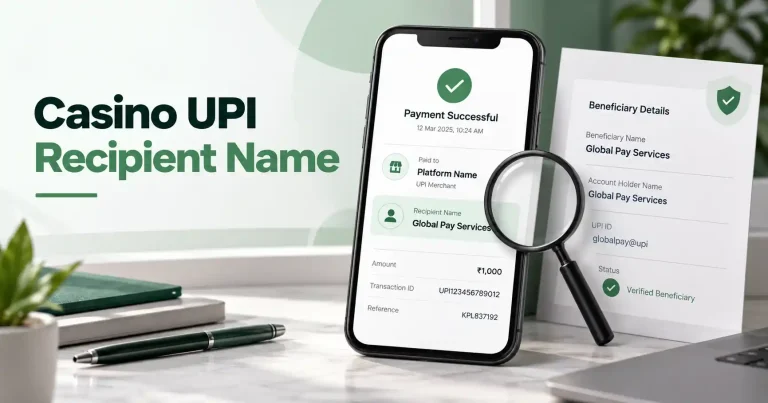
A casino deposit page may display one business name, but when you open your UPI application, the recipient appears under an unfamiliar personal or company name. This difference can raise questions about where the money is actually going.
A casino upi recipient name mismatch may occur because the platform’s public identity differs from the bank account holder or because a third party handles payments. However, a different beneficiary name does not establish a legitimate relationship. The important question is whether the recipient can be independently connected to the claimed merchant.
Understanding that distinction helps you assess unfamiliar payment details without making assumptions.
Why Does a Casino Deposit Display Someone Else’s Name?
The Difference Between a Casino’s Displayed Identity and Its Banking Beneficiary
A casino’s displayed name is not necessarily its registered business or banking identity.
A platform may operate under a public-facing brand while its financial accounts belong to a differently named legal entity.
However, this possibility does not confirm that any particular beneficiary is authorised to receive money for that platform.
The UPI beneficiary name identifies the receiving account holder. It does not independently establish that person’s or business’s relationship with a casino.
How Payment Intermediaries Can Affect the Recipient Shown
Some online businesses use third-party payment services rather than receiving every transaction directly.
A payment aggregator or processing partner may participate in collecting payments, depending on the arrangement.
This could explain certain differences between a merchant’s displayed identity and its payment details.
However, the existence of payment intermediaries in the wider UPI ecosystem does not prove that an unfamiliar casino recipient belongs to an authorised processor.
Why an Unfamiliar Name Does Not Establish a Legitimate Payment Relationship
An unfamiliar beneficiary name is not automatically evidence of fraud.
Equally, a technically valid UPI account does not establish commercial authorisation.
NPCI’s beneficiary-name verification requirements distinguish the bank-recorded recipient name from names supplied through QR codes or other labels for applicable transactions.
Is the Deposit Going to a Business Account or an Individual?
Recognising Personal Names in Casino Payment Instructions
Sometimes, a casino payment screen may lead to a UPI recipient identified by an individual’s name rather than a recognisable business.
That name could belong to an account holder with an undisclosed commercial relationship, but it may also be unrelated.
The name alone cannot establish which explanation is correct.
Understanding Person-to-Person and Merchant UPI Transactions
UPI supports both person-to-person (P2P) transfers and merchant payments.
A personal transfer generally involves sending funds to another individual’s account, while a merchant transaction involves a business payment arrangement.
NPCI recognises merchant-specific UPI infrastructure, including QR-based payments.
Why an Individual’s Account Requires Additional Explanation
When a casino presents itself as a business but supplies a personal beneficiary, there is an unanswered question about account ownership.
An individual might claim to collect payments on behalf of a merchant, but that claim needs supporting evidence.
Without an independently established relationship, the recipient’s personal identity cannot be treated as confirmation of business authorisation.
Why Might the Casino Provide a Different UPI Recipient Each Time?
Understanding Changes in Payment Instructions Between Sessions
A casino deposit recipient may appear different across separate payment attempts.
For example, one session might display a company name, while another presents an individual account holder.
Payment arrangements can vary, but the reason for a particular change cannot be determined from the names alone.
Each newly displayed recipient represents a separate identity that needs to be understood.
Distinguishing Documented Processor Changes From Unexplained Account Switching
A documented processing arrangement may identify the responsible payment company and explain its relationship with the merchant.
Unexplained account switching provides considerably less clarity.
If several unrelated names appear without identifying information or supporting documentation, users cannot reasonably determine whether they belong to one authorised payment arrangement.
The distinction is between a relationship supported by evidence and one based only on an assumption.
Why a Previously Successful Transfer Does Not Verify a New Recipient
A successful payment confirms that a transaction was processed. It does not prove that the recipient was authorised by the claimed merchant.
This distinction becomes especially important when the casino deposit recipient changes.
Previous payment activity involving one account cannot establish ownership, legitimacy, or authorisation for a newly supplied beneficiary.
What Evidence Connects the Recipient to the Casino?
Look for a Documented Relationship Between the Merchant and Beneficiary
The strongest evidence connects the receiving account to an identifiable business relationship.
Relevant information may include the merchant’s registered legal name, published business details, payment-service agreements, or independently verifiable processor information.
These details should be consistent with the claimed arrangement.
A matching business name alone is not conclusive, particularly when the receiving account belongs to another entity.
Check Whether the Payment Processor’s Identity Is Disclosed
If a casino claims that another company collects its payments, the processor’s identity should be identifiable.
Useful information includes its legal business name, official website, and any independently verifiable relationship with the merchant.
Where relevant, RBI records can also help establish whether a payment-service provider holds a claimed authorisation.
However, regulatory authorisation for a payment service does not automatically validate its alleged relationship with a casino or establish the legality of that casino’s activities.
Understand Why Customer-Support Assurances Are Not Independent Proof
Customer support may explain that an unfamiliar UPI beneficiary belongs to a payment partner.
Such an explanation provides context, but it remains a claim made by the platform.
Independent evidence should come from a source that can be checked separately, rather than relying entirely on the same website or support representative.
For anyone researching a casino upi recipient name difference, this separation between a claim and supporting evidence is particularly important.
Which Recipient-Name Differences Should Raise Concern?
An Unrelated Personal Name Without a Documented Explanation
A personal beneficiary with no identifiable connection to the casino deserves additional scrutiny.
The concern is not simply that an individual’s name appears.
It is the absence of evidence explaining why that individual is receiving funds on behalf of the claimed business.
Without this connection, the recipient’s authority remains uncertain.
Conflicting Beneficiary Information Across Payment Screens
Different names appearing on a website, QR-code label, and UPI confirmation screen can create confusion.
These fields may represent different information.
For applicable UPI transactions, NPCI requires the bank-recorded ultimate beneficiary name to appear rather than relying on a QR-code label or user-defined name.
An unexplained conflict between these details should not be dismissed merely because the payment screen appears functional.
Requests to Transfer Funds to Newly Supplied Accounts Outside the Original Checkout
Unexpected payment instructions sent through messaging apps, unofficial support accounts, or unrelated contact numbers introduce another layer of uncertainty.
The newly supplied account may have no demonstrated connection to the original merchant.
A request to use a different recipient outside the established checkout process should not be considered authentic simply because it mentions the casino’s name.
Conclusion
A different casino upi recipient name does not automatically indicate fraud, but it does not establish legitimacy either. Differences may involve legal business identities, account ownership, or third-party processing arrangements.
What matters is whether the receiving beneficiary can be independently connected to the claimed merchant. Where that relationship remains undocumented or inconsistent, the recipient’s authorisation remains unverified.