
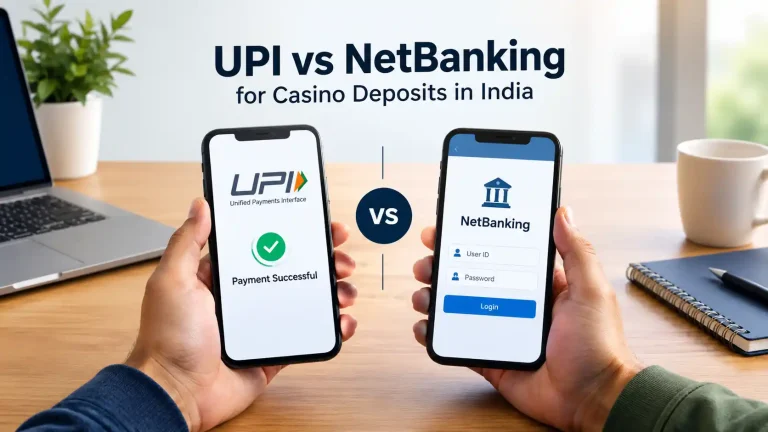
UPI vs NetBanking casino are two different ways to make online payments from a bank account. UPI uses a supported payment app, while NetBanking allows customers to authorise transactions through their bank’s online banking service. Their processing times, limits, security controls, and availability can vary.
When researching upi vs netbanking casino, it is important to understand that a payment method being available does not mean a particular casino transaction is permitted. Indian online gaming laws, bank policies, and payment-provider restrictions must also be considered.
What Is the Difference Between UPI vs NetBanking Casino?
UPI, or Unified Payments Interface, is a payment system developed by the National Payments Corporation of India (NPCI). It connects participating bank accounts through supported payment apps and enables electronic transfers.
NetBanking is a service provided by banks that lets customers access their accounts online. Customers can review balances, transfer funds, and authorise eligible transactions using the bank’s authentication process.
The main difference is how payments are authorised. UPI generally uses a UPI app and PIN, whereas NetBanking uses the bank’s online interface and its required authentication controls.
Neither method automatically confirms that a particular gaming website is genuine or legally permitted to accept payments.
How Do UPI and NetBanking Transactions Work?
UPI payments
UPI connects a payment request with the relevant bank account through a participating app. The payer reviews the request and authorises the transaction using the required authentication method. The payment system then processes the request and returns a status.
A transaction reference is usually available for record-keeping and payment enquiries.
NetBanking payments
NetBanking transactions are authorised through the customer’s bank. Depending on the transaction, the bank may require a login, an OTP, or another approved authentication method.
The bank processes the payment and provides a confirmation or failure status. A reference number may be available in the transaction history or confirmation message.
In both cases, the payment record, receiving service’s confirmation, and displayed account balance may not update at precisely the same time.
UPI vs NetBanking: Key Differences at a Glance
| Feature | UPI | NetBanking |
| Authorisation | Supported UPI app and PIN | Bank website or app and required authentication |
| User experience | Usually app-based | Uses the bank’s online banking interface |
| Processing | Designed for near-real-time payments | Depends on the transfer type and processing system |
| Transaction records | UPI app and bank statement | Bank transaction history and statement |
| Limits | Depend on transaction category, bank, and applicable rules | Depend on bank, account, and transfer type |
| Restrictions | Bank, app, and payment-provider controls may apply | Bank and payment-provider controls may apply |
| Common failures | Incorrect PIN, technical issues, limits, or declined requests | Authentication errors, limits, technical issues, or declined requests |
These differences describe general banking features, not the confirmed payment arrangements of any casino website. Availability and processing times depend on the institutions involved and the type of transaction.
Payment Processing Times and Transaction Status
A payment may take longer than expected because of bank-side checks, network interruptions, technical problems, or delays in updating the receiving system. UPI is designed for quick transfers, but that does not mean every transaction or account update will be immediate. NetBanking timelines also depend on the transfer type and institutions involved.
Three common transaction statuses are:
- Pending: The transaction has not reached a confirmed final state. The bank or payment system may still be processing it.
- Failed: The transaction was declined or did not complete. If the account was debited, the reversal may require additional time.
- Completed: The payment system reports success, although the receiving service may take time to reflect it.
If a payment discrepancy occurs, check the bank statement and transaction history. Keep the transaction reference number, date, amount, and any relevant confirmation message. Contact the bank through its official support channel if the debit and payment status do not match. Do not repeat a payment simply because a page has not updated.
UPI and NetBanking Limits, Fees, and Restrictions
Payment limits are not identical across all accounts or transactions. UPI limits may depend on the transaction category, participating bank, and applicable NPCI rules. NetBanking limits can depend on the bank, account type, and transfer method.
Fees may also vary. Some services have no separate customer transaction charge, while others may apply charges under their terms. Never assume a particular payment is free or that a displayed limit applies to every account.
For accurate information, consult the bank’s current fee schedule, transaction limits, and payment-service conditions. A website’s advertised limit does not override restrictions imposed by a bank or payment provider.
Privacy and Security Considerations
Both methods rely on authentication, but neither removes the risk of scams, fake websites, or unauthorised access.
Follow these basic precautions:
- Use official banking apps or verified banking websites.
- Never share your UPI PIN, NetBanking password, OTP, or other authentication details.
- Review the recipient and payment request carefully before authorising a transaction.
- Avoid suspicious links, unknown payment instructions, and requests to install unfamiliar apps.
- Keep banking apps updated and enable transaction alerts where available.
- Contact your bank immediately if you notice an unauthorised debit.
A UPI PIN authorises a transaction; it is not needed to receive money. Anyone asking you to disclose it is a warning sign. The same applies to NetBanking passwords and OTPs.
Payment security is also different from website trustworthiness. A legitimate payment system does not prove that a particular casino operator is genuine, financially reliable, or authorised to offer its service in India.
Conclusion
Understanding upi vs netbanking casino means looking beyond speed and convenience. UPI and NetBanking differ in authorisation, transaction records, limits, and processing arrangements, but both remain subject to banking controls and applicable law.
For anyone researching upi vs netbanking casino, the key consideration is not simply which payment method is available. It is whether the transaction is lawful, permitted by the relevant financial institutions, and supported by verifiable information. When these points are unclear, avoid proceeding and consult official sources before making a financial decision.