
An online slot generates each spin using a random number generator (RNG). The generated result is mapped to reel positions, displayed as symbols, and checked against the game’s paytable to determine whether the combination qualifies for a payout.
That is the basic answer to how online slots work. The spinning reels are mainly the visual presentation. Behind them, the important parts are the RNG, reel configuration, paytable, RTP, volatility and any bonus mechanics built into the game.
Understanding these elements makes it easier to read a slot’s information screen without assuming that animations, previous results or timing can predict what happens next.
How Do Online Slots Work?
A typical spin follows a short sequence:
Stake selected → Spin activated → RNG produces a result → Result maps to reel positions → Paytable checks the combination → Outcome appears on screen
The exact implementation varies between games, but this provides a useful simplified model.
What Happens When You Press the Spin Button?
Pressing spin tells the software to process a new game round. The RNG determines the underlying result according to the game’s programmed mathematics.
The reels then animate and stop at positions corresponding to that result.
This distinction matters. The reels are not physically deciding where to stop in the way mechanical slot reels once did. They are displaying an outcome produced electronically.
How the Software Turns a Random Result Into Reel Symbols
Behind the visible reels, slots can use virtual reel positions and mathematical mappings. The generated numbers correspond to particular reel positions or symbol arrangements.
Once those positions are established, the software displays the appropriate symbols and evaluates them according to the game’s rules.
What Is a Random Number Generator (RNG)?
An RNG is the mechanism responsible for producing unpredictable results.
In regulated digital gaming systems, RNG implementations may be tested to verify that outcomes operate according to the stated game design. The specific testing and regulatory requirements depend on the jurisdiction and platform.
How RNG Determines Each Spin
An RNG continuously or algorithmically produces values that the game can use to determine outcomes.
When a valid spin is initiated, the relevant generated value is translated into the reel configuration shown to the player.
Why Every Spin Is Independent
A key concept when learning how online slots work is that one random spin does not normally change the probability of the next simply because of what appeared previously.
In legitimate RNG-based slot software, individual spin outcomes are designed to be unpredictable and are not supposed to be influenced by previous ordinary spins.
For example, several spins without a particular symbol do not automatically mean that symbol is “due.”
This is why patterns visible in a short sequence of results should not be treated as reliable predictions.
How Reels, Symbols and Paylines Work
Reels are the vertical sections containing the game’s symbols. Rows describe how many symbol positions are visible horizontally across those reels.
A 5×3 layout, for instance, usually displays five reels with three visible positions on each reel.
Paylines vs Ways-to-Win Systems
Traditional slots use predefined paylines. A combination generally needs to appear on an active line according to the paytable’s rules.
Other games use systems commonly described as “ways to win,” where matching symbols may qualify without following a traditional fixed payline.
There are also cluster, cascading and other formats. This is why the information screen matters: two slots that look similar can evaluate combinations differently.
How Does an Online Slot Know When a Spin Wins?
The RNG provides the underlying outcome, but the game’s rules determine what that outcome means.
After the symbols have been mapped to the reels, the software compares the resulting arrangement with its paytable.
How the Paytable Defines Winning Combinations
A paytable explains which combinations are recognised and how their values are calculated.
It may show:
- Eligible symbol combinations
- Payline or ways-to-win rules
- Wild and scatter behaviour
- Bonus conditions
- Multipliers
- Feature-specific rules
Different symbols may also have different assigned values. A visually prominent symbol does not necessarily follow the same rules as another symbol.
What Does RTP Mean in Online Slots?
RTP stands for Return to Player. It represents a theoretical percentage of total stakes that a game’s mathematical model is designed to return over a very large number of rounds.
For example, a stated RTP of 96% does not mean that someone staking ₹100 should expect ₹96 back.
Why RTP Does Not Predict Your Individual Session
RTP is a long-term statistical measurement.
Short sessions can differ substantially from the theoretical percentage because individual results remain variable. One player could experience results far above the stated percentage while another experiences results far below it.
Neither short-term result changes what the published RTP represents.
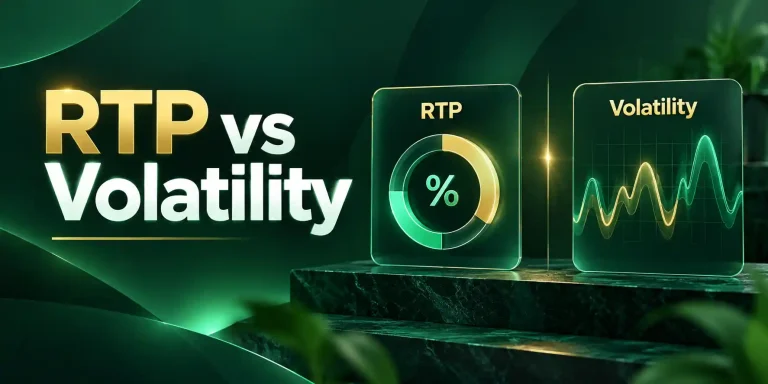
RTP vs Volatility: What Is the Difference?
RTP and volatility describe different characteristics.
| Concept | What it describes |
| RNG | How individual outcomes are generated |
| RTP | Theoretical return across extensive play |
| Volatility | How results may be distributed |
| Paytable | How qualifying combinations are evaluated |
What Low and High Volatility Mean
Higher-volatility games are generally designed so that payouts are distributed less evenly, while lower-volatility games tend to distribute results more frequently in smaller amounts.
These are mathematical tendencies over many rounds, not predictions for an individual session.
Why Similar RTP Does Not Mean Similar Behaviour
Two games can publish similar RTP figures while having noticeably different mathematical profiles.
That happens because RTP describes theoretical long-term return, whereas volatility concerns how outcomes are distributed along the way.
How Do Bonus Features Work in Online Slots?
Bonus features are additional rules layered onto the base game.
Common examples include wild symbols, scatter symbols, free-spin rounds, multipliers and cascading reels.
Wilds and Scatters
A wild may substitute for specified symbols when forming qualifying combinations. Its exact behaviour depends on the game.
Scatters often follow separate rules and may trigger a feature based on the number appearing rather than their position on a standard payline.
Free Spins, Multipliers and Cascades
Free-spin features provide additional game rounds under predefined conditions. Multipliers can modify values according to the game’s rules.
In cascading systems, symbols involved in a qualifying result may disappear and be replaced, potentially creating another evaluation within the same feature sequence.
These mechanics are game-specific, so their names alone do not explain exactly how they operate.
Are Online Slot Results Really Random?
For properly implemented RNG-based games, individual outcomes are designed to be unpredictable.
That also challenges several common slot myths.
Can Previous Spins Affect the Next Spin?
For independent RNG-based rounds, ordinary previous results do not make a particular outcome “due” on the next spin.
A long sequence without a particular symbol therefore does not prove that it must appear soon.
Can Timing the Spin Button Change the Result?
Trying to press spin at a particular second, stopping animations or watching for visual patterns should not provide a reliable method of predicting an independently generated result.
Animations can make the process appear physical, but the underlying mechanism is software-driven.
How RNG, RTP and Volatility Work Together
These three concepts become easier to understand when separated by purpose.
RNG answers: What is the individual outcome?
RTP answers: What theoretical return is built into the game’s mathematics over extensive play?
Volatility answers: How can results be distributed within that mathematical model?
None of them tells a player exactly what the next round will produce.
That distinction is central to understanding how online slots work without confusing long-term statistics with short-term predictions.
What Should You Check in a Slot’s Information Screen?
Before trying to interpret a game’s behaviour, read its information or paytable screen.
Look for the stated RTP where provided, the reel format, winning-combination rules, symbol values, wild and scatter behaviour, bonus conditions and any special mechanics.
Also check whether different game modes or configurations have separate rules. Details can vary between versions of a title or platform implementations.
Conclusion
Online slots may look complicated because of animated reels, special symbols and bonus rounds, but the underlying structure is easier to understand when each component has a clear role.
The RNG generates individual outcomes. Reel mappings turn those outcomes into visible symbols. The paytable determines how combinations are evaluated. RTP describes theoretical long-term return, while volatility describes the distribution of results.
Keeping those concepts separate is the simplest way to understand what the numbers and features on a slot’s information screen actually mean—and what they cannot predict.