
RTP, or Return to Player, is the theoretical percentage of total wagers that a slot game is designed to return to players over a very large number of plays.
For example, a 96% RTP means the game’s mathematical model is designed around a theoretical long-term return of 96% of total wagers. It does not mean that wagering ₹100 will automatically return ₹96 to an individual player.
RTP is a long-term statistical measurement. Individual spins and short playing sessions can produce results that are very different from the published percentage.
The key distinction is simple: RTP describes the game’s mathematics over many plays, not the result of your next spin.
What is the Slot RTP Meaning?
Return to Player is a statistical measurement built into a slot game’s mathematical design.
It represents the theoretical proportion of total wagers that may be returned as payouts across a sufficiently large number of plays. Actual individual results can differ substantially because slot outcomes involve chance.
RTP therefore tells you something about the game’s long-term mathematical model, rather than what will happen next.
How Does Slot RTP Work?
Consider a theoretical slot with a 96% RTP.
If a game’s 96% RTP were reflected across a very large sample in which ₹1,00,000 was wagered in total, the theoretical return would be ₹96,000. Actual results over any particular ₹1,00,000 of wagering could still be very different.
How Is RTP Calculated?
The basic concept can be expressed as:
RTP = Total amount returned to players ÷ Total amount wagered × 100
For example, If a game were designed around a theoretical return of ₹96 for every ₹100 wagered over the long run, that would correspond to a 96% RTP.
For commercial slot games, however, published RTP normally relates to the game’s mathematical design and theoretical performance rather than a calculation players need to perform themselves.
What Does a 95%, 96% or 97% RTP Mean?
These percentages describe different theoretical long-term returns.
| RTP | Theoretical meaning |
| 95% | ₹95 returned per ₹100 of total wagers over the theoretical long run |
| 96% | ₹96 returned per ₹100 of total wagers over the theoretical long run |
| 97% | ₹97 returned per ₹100 of total wagers over the theoretical long run |
A 96% RTP does not mean you will get ₹96 after wagering ₹100. One session could produce a very different result because short-term outcomes do not have to match the game’s long-term average.
RTP vs House Edge: What Is the Difference?
RTP and house edge describe related parts of the same mathematical model.
If a game has a theoretical RTP of 96%, the corresponding theoretical house edge is 4%.
In simplified form:
House Edge = 100% − RTP
So:
100% − 96% = 4%
RTP represents the theoretical proportion returned to players, while house edge represents the mathematical advantage built into the game over the long run.
Neither figure predicts what will happen during one session.
RTP vs Volatility: Why They Are Different
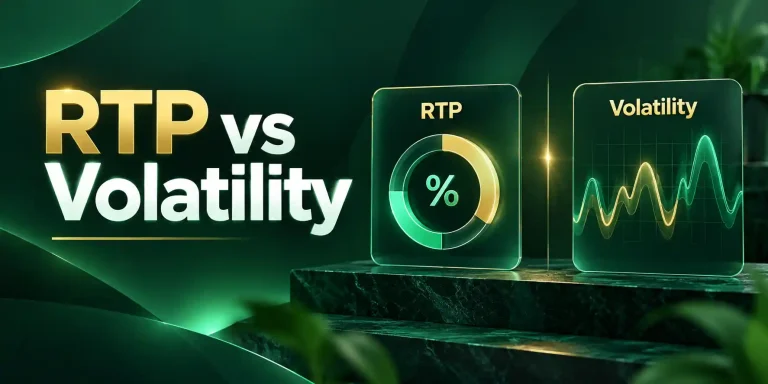
RTP and slot volatility measure different characteristics. The RTP concerns theoretical long-term return while Volatility concerns how outcomes may be distributed, including how frequently and how widely results can vary. This means two slots could theoretically have similar RTP percentages while having different volatility profiles.
Volatility should not be interpreted as a tool for predicting the next result. Like RTP, it describes characteristics of the game’s mathematical model rather than providing certainty about future outcomes.
Does Higher RTP Mean Better Individual Results?
Not necessarily. A higher RTP represents a higher theoretical return over the long run, but it does not predict the outcome of an individual spin or playing session. For example, a 97% RTP game has a higher theoretical long-term return than a 95% RTP game, but short-term results can still vary substantially because individual outcomes involve chance.
Some developers also offer the same slot in multiple RTP configurations. Check the game’s information panel, rules or official developer documentation to confirm which RTP applies to the version being used.
Where Can You Find a Slot’s RTP?
RTP information may appear in several first-party locations, depending on the game and platform:
- Game rules or information panel
- Paytable or help section
- Developer documentation
- Official game documentation
- Platform information
Check that the percentage applies to the specific version or configuration you are viewing.
Some games may be offered with different mathematical configurations. An RTP percentage quoted by a third-party website should therefore not automatically be assumed to apply to every available version.
What Should You Check When Reading RTP Information?
When researching a slot’s RTP, check the exact percentage and its source, whether it applies to the specific version being viewed, whether alternative RTP configurations exist, and what the official rules or paytable state.
It can also be useful to understand the game’s published volatility information because volatility and RTP describe different mathematical characteristics.
For Indian users, eligibility and availability should be checked separately. Gaming-related rules and platform requirements can vary by location, age and applicable terms.
Responsible Use and Slot Mathematics
Slot RTP meaning is primarily an educational concept for understanding how slot mathematics works.
It does not provide a method for predicting individual outcomes, eliminating chance or guaranteeing returns. Slot games should not be treated as a source of income.
Users should also review applicable age requirements, local restrictions, platform rules and responsible-use information before participating in gaming activities.
Final Takeaway
The slot rtp meaning tells you how a slot is mathematically designed to perform across a very large number of plays. A 96% RTP describes a theoretical long-term return of 96% of total wagers, not a promise that ₹100 wagered will return ₹96.
Use RTP to understand and compare a game’s mathematical structure, alongside factors such as volatility and house edge. For a specific game, check the RTP shown in its official rules or information panel because different versions may use different configurations.