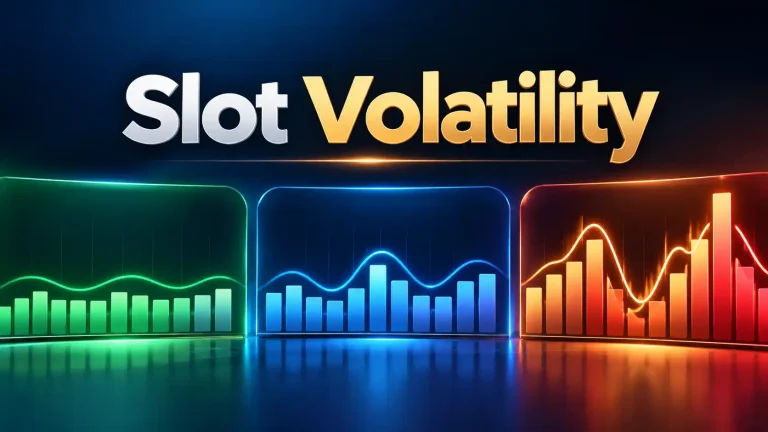
Slot volatility describes the general pattern of payouts built into a slot game’s mathematics. It mainly indicates how often payouts may occur and how much their sizes can vary over a large number of plays.
A lower-volatility game generally produces smaller payouts more frequently, while a higher-volatility game tends to have less frequent payouts with the possibility of larger amounts. These are long-term characteristics, not predictions. Volatility cannot tell you what will happen on the next spin or during a particular session.
What Does Volatility Mean in Slots?
Volatility, sometimes called variance, describes how a game’s payouts are distributed in terms of frequency and size.
It helps explain the mathematical character of a game, but it does not create a fixed payout schedule. A low-volatility game can still have a losing stretch, while a high-volatility game can produce several payouts close together.
The classification describes an overall probability pattern rather than a guaranteed sequence of results.
Low vs Medium vs High Volatility
The three common categories provide a simple way to describe different payout patterns:
| Volatility Level | General Payout Pattern | Payout Frequency | Typical Payout Size |
| Low | More frequent, generally smaller payouts | Relatively higher | Generally smaller |
| Medium | More balanced or mixed pattern | Moderate | Moderate or mixed |
| High | Less frequent, potentially larger payouts | Relatively lower | Can be larger |
These are general characteristics rather than guarantees. There is also no universal mathematical boundary separating low, medium and high volatility. Providers may calculate or label these categories differently.
What Is a Low-Volatility Slot?
A low-volatility slot is generally designed to produce payouts more frequently, with individual payouts tending to be smaller than those in higher-volatility games.
That does not mean losses are unlikely or that frequent payouts protect a player’s money. Smaller payouts may still be less than the total amount wagered over time.
What Is a Medium-Volatility Slot?
Medium volatility generally refers to a middle range between low and high variance.
Such games may combine relatively regular smaller payouts with occasional larger outcomes. However, “medium” is not a precise universal mathematical standard unless the developer explains how the classification is calculated.
Two providers could use the same label for games with noticeably different payout patterns.
What Is a High-Volatility Slot?
A high-volatility game generally has less frequent payouts and may include a wider range of payout sizes, including larger potential outcomes.
Longer periods without a payout can therefore occur.
Larger potential payouts should not be interpreted as a higher probability of profit. The volatility level alone does not indicate whether a particular session will finish with a positive or negative result.
How Does Volatility Work?
A game’s overall behaviour comes from its mathematical design.
Symbol probabilities, winning combinations, the paytable, bonus mechanics and the distribution of different payout values can all influence variance.
One game may distribute more of its payout activity across many smaller outcomes. Another may concentrate more of it into less frequent, larger outcomes.
These patterns become meaningful over many plays. Short sessions can look very different because random outcomes do not have to follow the long-term pattern neatly.
Volatility vs RTP: What Is the Difference?
They measure different characteristics.
RTP (Return to Player) is the theoretical proportion of total wagers that a game is designed to return as payouts over a very large number of plays.
Volatility describes how those payouts may be distributed in terms of frequency and size.
Two games can therefore have similar theoretical RTP figures while producing very different payout patterns.
RTP also does not tell an individual player what they will receive during one session. It is a long-term theoretical measure, not a personal return guarantee.
Does High Volatility Mean Higher RTP?
No. High volatility does not automatically mean high RTP, just as low volatility does not automatically mean low RTP.
RTP concerns theoretical long-term return. Volatility concerns payout distribution.
Because they describe different parts of a game’s mathematical model, one should not be assumed from the other. Check the game’s published information where available.
How Can You Find a Game’s Volatility?
Start with first-party information. A volatility or variance rating may appear in:
- The game information or help section
- The paytable and rules
- Developer documentation
- Official game specifications
Not every provider publishes this information.
If no official rating is available, third-party descriptions should be treated cautiously. A third-party claim that a game is “high volatility” is not necessarily equivalent to a classification published by the developer.
Can Volatility Predict Slot Results?
No. A volatility rating cannot predict when a payout will occur, whether the next spin will produce a win, or what the result of a session will be.
It describes general mathematical behaviour across many outcomes.
Past results also do not make a future payout “due”. A sequence of losing spins does not mean that a larger payout must follow.
Why Short-Term Results Can Look Different
A short session contains only a limited number of outcomes, so its results may differ substantially from a game’s long-term mathematical pattern.
Low volatility does not mean payouts must appear at regular intervals. Likewise, high volatility does not require a specific number of losing spins before a larger payout occurs.
Volatility describes probabilities, not a sequence the game must follow.
What Should Players Check Before Playing?
Useful information to review includes:
- Published RTP information
- Volatility or variance rating, if available
- Paytable and payout rules
- Bonus-feature conditions
- Maximum-payout information where relevant
- Game rules
- Developer or provider information
- Age and location restrictions
- Platform terms
- Responsible-gaming information
Real-money gaming availability, platform terms and applicable requirements can vary by location and may change. Current official information is more reliable than old screenshots, forum discussions or unsupported third-party claims.
Conclusion
Volatility is useful for understanding the general payout pattern built into a slot game’s mathematics. Lower-volatility games generally distribute payouts more frequently in smaller amounts, while higher-volatility games tend to produce less frequent payouts with a potentially wider range of values.
Those patterns are not predictions. Individual results remain uncertain, and neither previous spins nor a volatility rating can tell you what will happen next.
The key distinction is straightforward: RTP describes theoretical long-term return, while volatility describes the general pattern in which payouts may occur.